

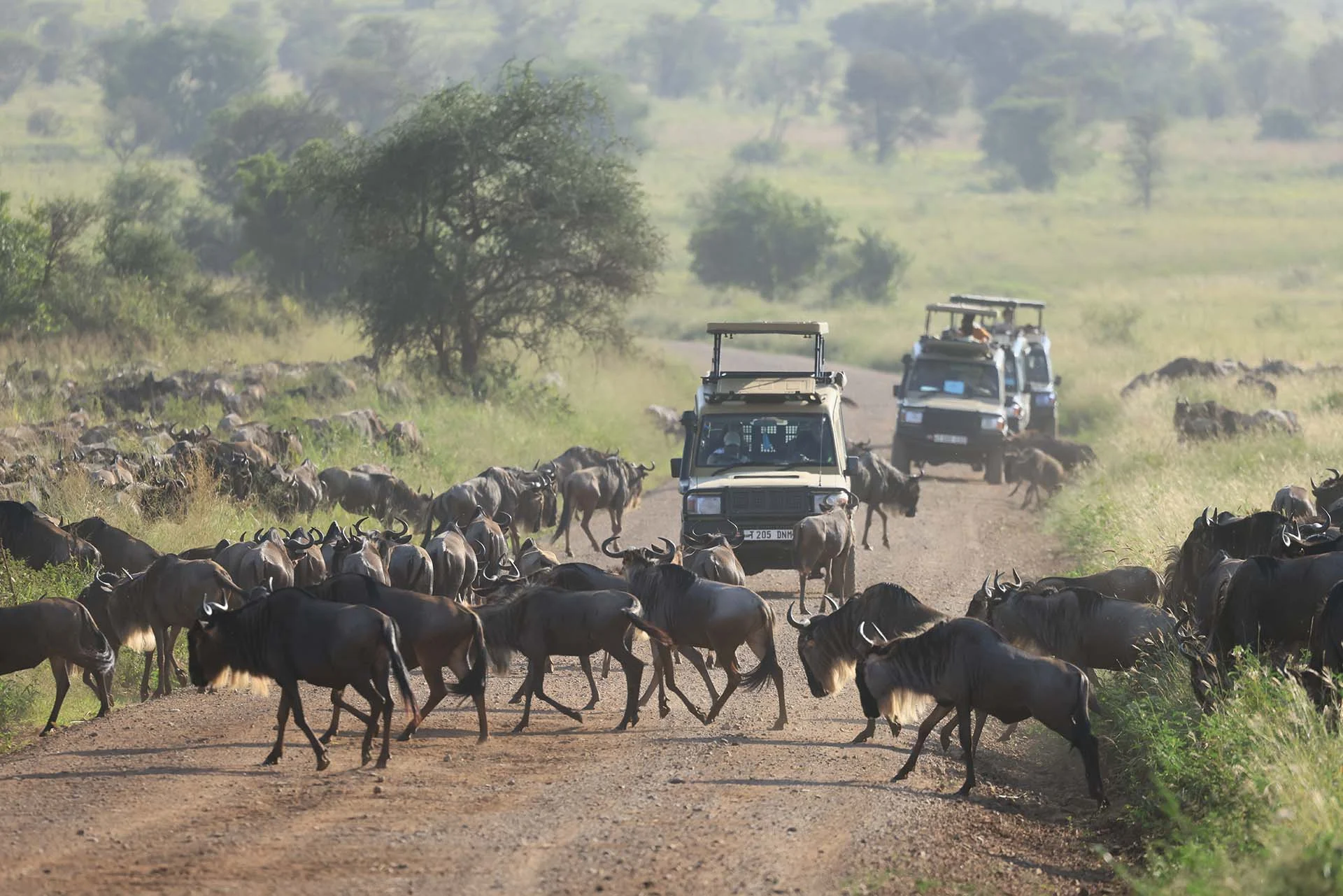
Masai Mara in February 2027: the Calving Season Overlap, the Cross-Border Migration Phase and the February Mara Wildlife
The Masai Mara in February 2027 is one of the most strategically interesting single months in the East Africa safari calendar — the month that spans the end of the Serengeti’s calving season [the Tanzania Ndutu / short-grass-plains calving of December to February] and the beginning of the northward buildup that will eventually bring the 1.3 to 1.5 million Wildebeest back to the Masai Mara by July. February in the Mara is not the calving itself [the calving being concentrated in Tanzania’s Ndutu area, a 6 to 9 hour drive south of the Masai Mara] but the immediate pre-departure buildup phase — the February Serengeti’s Wildebeest beginning to move north from the Ndutu short-grass plains toward the Serengeti’s central corridor by February’s final week, with the leading edge of the northward migration sometimes visible in the Mara ecosystem’s southern extension zone [the Loita Plains to the east and the Trans-Mara corridor to the west] by early March. The February Mara’s resident wildlife: the Masai Mara ecosystem in February 2027 supports the same resident-wildlife complex as January [40,000 to 80,000 resident Wildebeest, 15,000 to 25,000 resident Zebra, 30,000 to 50,000 Thomson’s Gazelle, and the Mara’s resident predator populations] but with 3 February-specific conditions that distinguish February from January: [1] the February Mara’s grass state at the annual-calendar’s lowest single-month height [the January-break dry-air period’s grass-reduction continuing through February’s first 2 weeks, producing the lowest mean grass height of the year — 10 to 25 centimeters in the open plains — before the March long-rains’ onset reverses the trend], [2] the highest single-month dust conditions in the Mara ecosystem [the February dry-air’s soil-surface desiccation producing dust-plumes visible from moving game-drive vehicles at 300 to 600 meter distances — the highest single-month dust level of the annual calendar], and [3] the Mara River’s lowest single-annual water-level [the February dry-air period’s evapotranspiration maximum and the absence of any rainfall input producing the Mara River’s lowest water-level of the year — the hippo pods concentrated in the Mara River’s deep-pool remnants at higher density than any other single month, producing the highest single-month hippo-pod-viewing frequency in the annual Mara calendar].
Masai Mara in February 2027: the Low-Water Mara River, the Hippo Calendar and the Crocodile Monitoring Season
Masai Mara in February 2027 — the Mara River in February, the hippo concentration and the Nile crocodile’s February behavior: the Mara River in February is at its most ecologically concentrated state of the annual calendar — the absence of the migration [and the migration’s Mara River crossing events that in July and August distribute the crocodile population across 12 to 18 active crossing sites] means that the February Mara River’s Nile crocodile population [estimated 800 to 1,200 individuals across the Mara River’s Kenya section from the Tanzanian border to the Mara Triangle’s northern boundary] is concentrated in the river’s permanent-water sections in February at a density 3 to 4 times higher than the July migration-crossing dispersal period. The February crocodile behavior: the Nile crocodile [Crocodylus niloticus] enters the February period in the thermoregulation-priority behavioral mode [the February Mara River’s water temperature of 22 to 26 degrees Celsius producing the crocodile’s “basking maximum” daily behavior — 6 to 8 hours of bank-basking per individual per day vs the July-August migration-crossing period’s 2 to 4 hours of basking] with the result that the February game-drive visitor to any of the Mara River’s 9 accessible bank-viewing sites observes the highest single-site crocodile-basking count of the annual calendar [the February count of 40 to 80 crocodiles per accessible bank section vs July’s 15 to 30 — the July crocodile’s behavioral energy being directed at the crossing Wildebeest rather than bank-basking]. The hippo concentration: the Mara River’s February low-water pools concentrate the Mara ecosystem’s hippo population of 2,800 to 3,400 individuals [the 2024 KAZA census extended to the Masai Mara ecosystem, the highest single-ecosystem hippo population density in Kenya’s protected area network] into the river’s deepest-remaining pools [the February pool-depth dropping from the July high-water depth of 3 to 5 meters to the February low-water depth of 1.2 to 2.4 meters in the Mara Triangle’s main-channel sections] — the result being the February hippo-pod viewer’s count of 80 to 160 hippos per accessible pool vs July’s 30 to 60 [the July rains expanding the river’s width and allowing the hippo to space out across a wider water surface]. The February Mara River itinerary: the 3-pool loop [the Mara Triangle’s Crossing #1 pool, the Crossing #4 pool, and the Crossing #7 pool] can be completed in a single 4-hour morning game-drive from any Mara Triangle camp, producing the February visitor’s highest single-day hippo-and-crocodile combined viewing count of the annual calendar.
Masai Mara in February 2027: the Open-Grass Plains, the Predator Visibility Peak and the February Photography Conditions
Masai Mara in February 2027 — the open-plains game-drive conditions, the predator visibility maximum and the February photography: the February Masai Mara’s 10 to 25 centimeter grass height produces the highest single-month predator-visibility-from-vehicle in the annual calendar — the low grass allowing the game-drive vehicle to observe a lion [mean shoulder height 90 to 110 centimeters] at 400 to 800 meter distances across the open plains [vs November’s 60 to 80 centimeter grass limiting the lion-sighting distance to 80 to 200 meters in the dense-grass sections and the July migration peak’s 40 to 60 centimeter grass limiting the non-kopje lion-sighting to 200 to 400 meters]. The February cheetah visibility: the cheetah [mean shoulder height 65 to 80 centimeters] is the single species that most benefits from the February low-grass conditions [the cheetah’s lower shoulder height making it the predator most concealed by 40 to 80 centimeter grass in the peak-season and the most visible in the February 10 to 25 centimeter short-grass] — the February cheetah sighting frequency from the game-drive vehicle being the highest single-month sighting frequency in the annual calendar at the open-plains sites [the February cheetah-to-vehicle sighting ratio of 1 cheetah sighting per 2.8 to 4.2 drive-hours vs October’s 1 per 3.5 to 5.8 drive-hours — the February’s 22 to 35 percent higher sighting efficiency being entirely attributable to the lower-grass open-sight-line]. The February photography: the February Mara’s photography conditions are the most technically demanding of the annual calendar — the low grass produces the highest-quality sight-line for the wildlife telephoto [400 to 600mm] but the dry-air February conditions produce the atmospheric-haze distortion that reduces the long-distance telephoto sharpness [the heat-shimmer above the February ground-surface affecting all telephoto compression shots above 400mm at distances above 200 meters between 9 AM and 4 PM]. The February photography strategy: early-morning game drives [departing at 5.45 to 6.15 AM] and late-afternoon game drives [departing at 4 to 4.30 PM] allow the photographer to capture the February Mara’s exceptional wildlife-access and open-grass sight-lines in the pre-heat-shimmer morning-cool window and the post-heat-shimmer late-afternoon-cooling window, avoiding the 9 AM to 4 PM atmospheric distortion period for all telephoto-compression shots.
Masai Mara in February 2027: Camp Selection, the Value Window and the February Safari Planning
Masai Mara in February 2027 — the accommodation recommendations, the February rate structure and the planning summary: February 2027 in the Masai Mara offers the year’s third-lowest accommodation rates [behind December 1 to 20 and January — the February rate of to per person per night at the Mara’s luxury conservancy camps representing 38 to 52 percent savings relative to July’s to ,100] combined with the highest single-month predator-visibility conditions of the year [the February low-grass open-plains producing the best predator-sight-line of the calendar year] and the lowest single-month vehicle-per-sighting count [the February vehicle-per-predator-sighting of 2 to 4 vs July’s 15 to 35]. The 4 recommended February 2027 Mara camps: [1] Ol Seki Camp [the Naboisho Conservancy’s small 6-tent luxury camp at to per person per night February 2027 — the Naboisho’s 30 to 40 vehicles maximum across the 50,000-hectare zone producing the most vehicle-exclusive February game-drive in the Mara ecosystem and the Naboisho’s acacia-woodland and open-grass interface being the single most diverse February habitat for the combined big-cat, bird, and resident-wildlife February visit]; [2] Porini Lion Camp [the Olare Motorogi Conservancy at to per person per night February — the “Lion Camp” name reflecting the Olare Motorogi’s lion-sighting reputation, the February low-grass producing the camp’s highest-rated single-month lion-visibility period in the annual guide-assessment data]; [3] Basecamp Masai Mara [the Masai Mara National Reserve’s most sustainable-tourism-certified camp at to per person per night February — the MMNR positioning accessing the open-plains’ February short-grass without the conservancy fee but with the higher vehicle count of the MMNR vs the conservancy network]; and [4] Cottars 1920s Camp [the Olderkesi Conservancy’s exclusive camp of 9 tents at to per person per night February — the Olderkesi’s less-trafficked position in the Mara’s eastern zone producing the lowest February vehicle count of any accessed camp in the ecosystem and the highest February leopard sighting frequency of any Mara camp east of the main Seronera-Mara Road]. Confirm February 2027 dates with 6 to 9 months advance notice — the February Mara’s availability window being approximately equal to January’s 15 to 30 percent advance-booking rate at the premium camps as of mid-2026.